
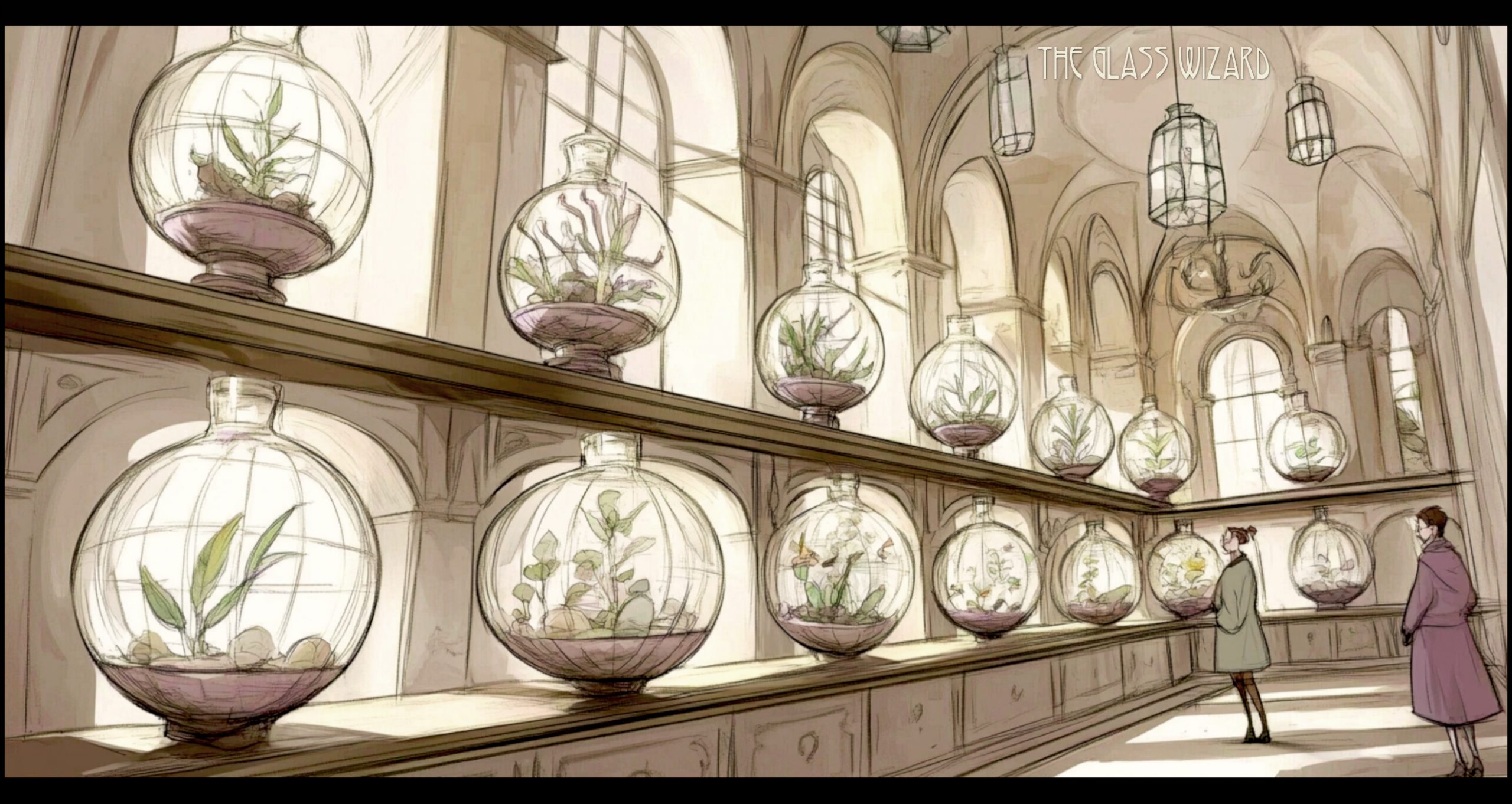
The Green Grimoire features a record of the plants that appear in the narration
— flora wild and wondrous, mystic and mundane.
Click on the respective plant’s name to see its description.
A
B
Bermilla
Potent in the flask, perilous in the breath.
A hardy perennial native to damp forest undergrowth and shaded ravines, the bermilla thrives in moist, acidic soil and is recognised by its narrow, dark-green leaves, which grow close to the ground, and its dense system of knotted, woody roots. The root itself is pale and fibrous, often resembling rotten wood until cut open, whereupon it releases a sharp, bitter scent that causes dangerous lung injuries when inhaled. Its medicinal resin is most concentrated in late summer, when the roots are carefully pried from the soil rather than cut, as premature splitting weakens their potency. Several roots are required to prepare Bermillion, a solution used to numb and treat abrasions, shallow cuts, and surface burns, though stronger preparations may cause lasting scar tissue.
First mentioned: Alchemy and Apothecary Glossary; as base ingredient for the Bermillion Potion, which first appears in [B2.C9].
Borrin Shrub [Ignifera Tenebris]
More a root structure than a plant, growing in the Northlands desert.
A rare and resilient plant, the Borrin Shrub thrives in dry, windswept plains and rocky outcroppings where few other plants can survive. Its gnarled roots burrow deep into the earth, drawing up trace minerals that give it its distinctive fire-sustaining properties. The shrub’s small, dark crimson leaves curl inward during the day to conserve moisture, unfolding only at night to absorb the cool air.
The true value of the Borrin Shrub lies in its roots, which, when dried and ground into Borrin Powder, create a smokeless, long-burning fire accelerant. Local legends claim that ancient wanderers discovered the plant when they found embers still smoldering beneath its roots long after a wildfire had passed. Some cultures revere the shrub as a sacred gift from fire spirits, while others harvest it carefully, knowing that excessive use can lead to its slow disappearance from the land.
First mentioned: [B2.C4]
C
D
E
F
G
Glassweed
The crystal herb of still winters.
A rare and delicate growth found only in the cold reaches of the Albweiss, where ice and stone meet. Its translucent fronds resemble frozen shards of glass, catching and refracting the faintest light. Harvesting glassweed is perilous, for it grows half-buried in ice, and a careless touch may shatter its brittle stems. When steeped, it yields a pale tincture said to steady the breath and sharpen the clarity of thought, though its strength fades quickly once removed from its frozen home. For this reason, apothecaries value it highly, keeping it preserved in blocks of ice until needed.
First mentioned: Alchemy and Apothecary Glossary; in relation to making Purging Draught, which appeared in [B2.C9].
H
I
J
K
Korvith Nut
The crystal herb of still winters.
The korvith nut is a small, hard-shelled nut native to the rocky slopes and marshy areas of the western Swamplands. Known for its bitter flavour, the nut grows on a low-lying shrub with thick, leathery leaves. When collecting korvith nuts, it is crucial to look for specific signs that the plant has not been tainted by swamp water, which can seep into the ground, even beneath a healthy-looking surface layer. If the shrub has absorbed water from the swamp, the nut may become dangerously toxic. Local belief holds that the waters of the swamp are cursed by witches, and those who eat korvith nuts grown in these contaminated areas are said to suffer grave harm.
First mentioned: Grog and Grub Glossary; in relation to making Estjeque, which appeared in [B2.C12].
K
L
M
Mikkin
The crystal herb of still winters.
The mikkin is a small, round fruit native to the southern Midlands and Southlands, prized for its sweet-tangy pulp. It has a thin, smooth skin that ranges from pale yellow to light green when ripe. The fruit grows on a hardy shrub-like plant that thrives in mild climates. When first introduced to the eastern Northlands, the mikkin struggled to grow in the harsh desert climate. However, its cultivation was made possible through careful irrigation techniques using the many rivers in the region, allowing the plant to adapt and flourish in the eastern Northlands' heat. The plant requires a steady supply of water to produce fruit, making it well-suited for the river-fed plains where it is now grown.
First mentioned: Grog and Grub Glossary; in relation to making Mikkin Juice, which appeared in [B2.C12].
N
O
P
Q
R
Redfire Pirne
A tree of fire and myth.
The Redfire Pirne is a tall, resinous conifer found on rocky uplands and windswept ridges, recognisable by its reddish bark that flakes in ember-like patterns. Its needles grow in thick clusters of five, giving the tree a bristling crown that resists both frost and drought. The resin is highly flammable, burning with a bright crackling flame, and is used for torches and in medicines such as Bermillion, where it acts as a natural preservative.
Woodcutters prize the timber for its strength, though it must be seasoned carefully to prevent sparking when freshly cut. Herbalists note that inhaling its smoke clears the lungs in small doses, but causes dizziness in excess. Folklore claims that the first Redfire Pirnes were struck by lightning and still carry fire within; to this day, travellers place one a cone in their hearths for good fortune, while others believe burning one indoors without planting another invites ruin.
First mentioned: Alchemy and Apothecary Glossary; in relation to making Bermillion, which appeared in [B2.C9].
Rinza
Versatile grain of the Barnstreams.
Rinza is a pale, moon-silver grain grown in the cloud-veiled terraces of the Narethian highlands at the foot of the eastern Albweiss mountains. Its stalks sway tall and whisper-thin amidst the ancient windtrees, thriving only in soils fed by glacial springs. Each kernel is smooth, oblong, and faintly luminescent. Rinhza is harvested at dusk during the Season of Still Rain. It is steamed for ceremonial feasts or ground into flour for daily meals. It can also be brewed into a mild, grounding tonic prized among the children of the Barnstream.
First mentioned: [B2.C4]
S
Sleeprot Stems
A tree of fire and myth.
Sleeproot stems are thick, fibrous plants that grow in dark, humid soil. Their roots exude a soporific sap, which can be carefully extracted and used to induce rest or ease mental tension. When sliced and dried, the stems are often included in salves or teas to calm overactive nerves. Alchemists caution that even a slight overdose can lead to deep, prolonged slumber, so precision in preparation is key.
First mentioned: Alchemy and Apothecary Glossary; in relation to making Numa Salve, which appeared in [B2.C9].
Sulfar Tree
A fast growing tree rapidly overtaking the Midland forests. Full of berries.
The sulfar tree is a fast-growing, hardy tree native to the Midland forests, often regarded as a nuisance due to its rapid spread. With thick, dark green leaves and rough, bark-covered trunks, the sulfar grows at an alarming rate, pushing out slower-growing plants and dominating the underbrush. Its aggressive growth is a challenge for local farmers, who must constantly clear land to prevent it from overtaking crops.
Its berries are small, no larger than half a centimetre in diameter. When ripe, they turn bright orange, hanging in large clusters along the branches. These berries are highly sought after for their tangy, slightly bitter flavour. Due to their abundance, they are often harvested in large quantities, making them a common sight in the marketplace. The berries are usually picked during the late summer months when they reach full ripeness. Because they are easily squashed, it has become common practice to combine harvesting with efforts to cut back the trees' growth: people cut off the fruit-bearing branches rather than picking the berries individually. This, on the markets around the Midland villages, they are sold per branch. People take the branches home and pick the berries themselves, based on their needs.
First mentioned: Grog and Grub Glossary; in relation to making Sulfa Spirit, which appeared in [B2.C12].
T
Tona Tree
Its pale bark cleanses wounds but may drown the body in sleep.
A towering, frost-hardy tree native to cold mountain forests and shaded highland valleys. It is recognised by its broad crown, dark outer bark, and unusually pale inner bark, which contains a cooling, antiseptic essence. When cut at certain temperatures, the trunk is said to produce a faint, sustained hum, though scholars disagree whether this is caused by contracting fibres or some deeper property of the living wood. The inner bark reaches its greatest potency at first frost and must be scraped carefully without girdling the trunk, as excessive harvesting can kill even mature trees. Its roots grow deep and densely intertwined, giving rise to the old belief that tona trees store dreams beneath the earth. The bark is commonly steeped into a dark amber syrup used for cleansing and reducing fever, but its natural compounds are dangerously sedative in concentrated doses and may slow the heart to a fatal stillness.
First mentioned: Alchemy and Apothecary Glossary; in the article about Tona Bark Syrup, which appeared in [B2.C9].
U
V
W
X
Y
Z